When you are about to cross the street, would you be startled if someone suddenly came up and grabbed you? If so, is not it also an offense when someone sees a person with a visual impairment and forcibly pulls them across the street without their consent? In everyday life, many acts of overprotection or excessive pity—or remarks that imply stereotypes—may seem unintentional, but they can inadvertently cause pain and harm to persons with disabilities.
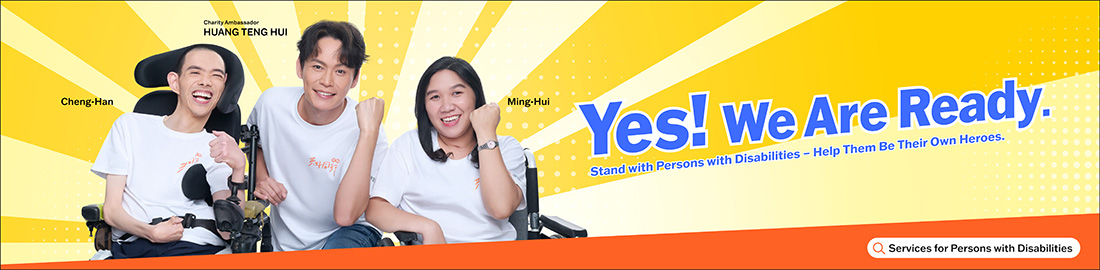
Eden Foundation’s “Service Programs for Persons with Disabilities” has kicked off. Under this year’s theme, “Yes! We are ready!”, the program strongly advocates for the creation of a barrier-free society, emphasizing that the government, society, and professional services are all indispensable. The government must keep pace with the times by amending laws and reforming systems to ensure that persons with disabilities enjoy equitable and accessible rights; the general public must adjust discriminatory behaviors and overcome prejudiced attitudes to enable persons with disabilities to thrive in the common good also inclusive society; and providing diverse, tailored professional services to meet the needs of different disabilities is the most critical cornerstone. When these three forces are in place, persons with disabilities will have sufficient support to access opportunities, take charge of their lives, and become the heroes of their own stories in a barrier-free environment!
.jpg)
To help the public understand how existing prejudices and stereotypes create numerous obstacles in the lives of persons with disabilities, undermine their dignity, and ultimately hinder their social participation, Eden recently conducted a survey on “Perceptions of Stereotypes and Prejudice.” The results revealed that when faced with “unwanted physical contact” or “stigmatizing language that conveys obvious pity or implies a denial of their abilities,” the public’s perceived level of offense approached the maximum score of 5; however, when faced with subtle remarks in daily life such as “generalizations” or “excessive praise,” fewer than one-fifth of respondents felt uncomfortable. This indicates that the general public still lacks sufficient awareness and sensitivity toward subtle, hidden biases in everyday life.
In addition, Eden conducted a “Daily Perception of Disability Bias” survey among frontline professional service providers to identify the most common forms of bias encountered by persons with disabilities in daily life or the workplace. The top five were: “unable to live independently” (80.6%), “deserving of pity” (68.9%), “unable to work” (66.5%), “should just stay at home” (51.0%), and “should be treated” (49.0%). The concepts underlying these responses deny the possibility of independent living for persons with disabilities, undermine their dignity and diversity, and further obstruct their right to participate in society.
.jpg)
In response, Mr. Tine-Yuang Ho, CEO of Eden Foundation, stated that persons with disabilities are members of society who should enjoy the same basic rights to healthcare, education, housing, employment, and social participation without having to fight for them. However, for a long time, persons with disabilities have often been viewed by the general public as “vulnerable persons who are pitiful and full of limitations” or as inspirational, optimistic fighters for life; These unconscious biases, which appear in writing, speech, and cultural codes, often cause invisible harm. Mr. Tine-Yuang Ho emphasized that every person is an equal individual; we should replace “pity” with “empathy” and “tolerance” with “respect.” Guided by the principle of do unto others as you would have them do unto you—if you would find a certain treatment uncomfortable, you should not impose it on others—we can raise overall awareness of disability etiquette.
With the right support, persons with disabilities can prepare themselves for life. Ming-Hui, who recently received the Yilan County Government’s 2025 “Courageous Award” for Outstanding Persons with Disabilities, was involved in a severe car accident as a child. After being in a coma for more than eight months, she miraculously awoke—though the accident left her with cerebral palsy and paralysis on the right side of her body. When she first arrived at Eden’s Yilan Education and Nursing Institute, she struggled to adjust and experienced emotional instability. Social workers not only thoughtfully arranged for her to return home on weekends to spend time with her family and replaced her medical bed to address difficulties with toileting but also designed a customized physical rehabilitation program for her. With the encouragement of the institute, Ming-Hui has now become the captain of the boccia team; her life is fulfilling and cheerful, and her passion for life has been reignited.
.jpg)
Another resident is 33-year-old Cheng-Han, who was born with cerebral palsy and suffers from severe muscle spasticity, requiring complete dependence on others for daily living. However, with his sensitive nature and a stubborn yet confident determination to do what he can, he initially struggled to adjust when he first arrived at the Ta-Lung Disability Care Center, as he missed home. However, the center’s professional team provided him with comprehensive support. For example, an occupational therapist developed a rehabilitation plan to strengthen the muscles in his left hand and helped him transition to an electric wheelchair equipped with a positioning system to slow the progression of scoliosis, gradually building his confidence in his “independence.” Now, Cheng-Han is able to participate comfortably in various activities and interacts well with community members at the center’s flea market. A social worker shared: “Cheng-Han is now like a little sun, radiating boundless energy.”
.jpg)
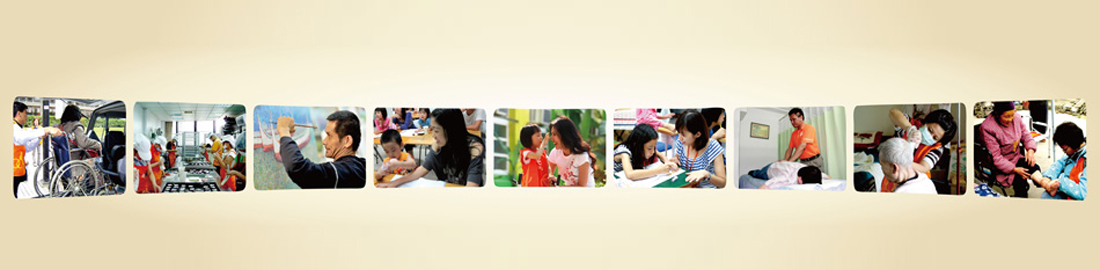
For 44 years, Eden has provided diverse services—including daily living care, rehabilitation and reablement, supported employment, and assistive device support—tailored to the varying needs of persons with disabilities. We also operate collaborating sites for people with psycho-social disability, small-scale community workshops, and daycare centers, offering professional support to guide families with disabilities through their most critical moments when they need it most. We sincerely invite the public to support the “Service Programs for Persons with Disabilities” and assist them take steps toward greater opportunities, take control of their lives, and become the heroes of their own stories. For more details, search for “Eden Services for Persons with Disabilities” or call the support hotline at 0800-025-885.